Last updated: September 30, 2026 · Written by anglers who have killed more than one battery halfway down a shoreline.

Check price

Best Trolling Motor Battery Guide: Lithium, Deep-Cycle & AGM Options (12V, 24V & 36V)

Trolling Motor Battery Buying Guide (2026 Update)

The wrong trolling motor battery doesn't fail at the dock. It fails two coves from the ramp, with the wind picking up and the fish finally biting. We've been there. This guide exists so you pick right the first time.

Below you'll find the three battery types that actually belong on a boat, a plain-English sizing method (thrust to voltage to amp-hours), a side-by-side comparison table and our category picks, from the best trolling motor battery overall to a light pack for a kayak. No spec-sheet fog, just the numbers that decide how long you stay out.

Amazon prices move daily, so we don't quote them here. Every pick links to today's listing.

Check price

Prices and stock change often. One click shows you today's numbers on Amazon.

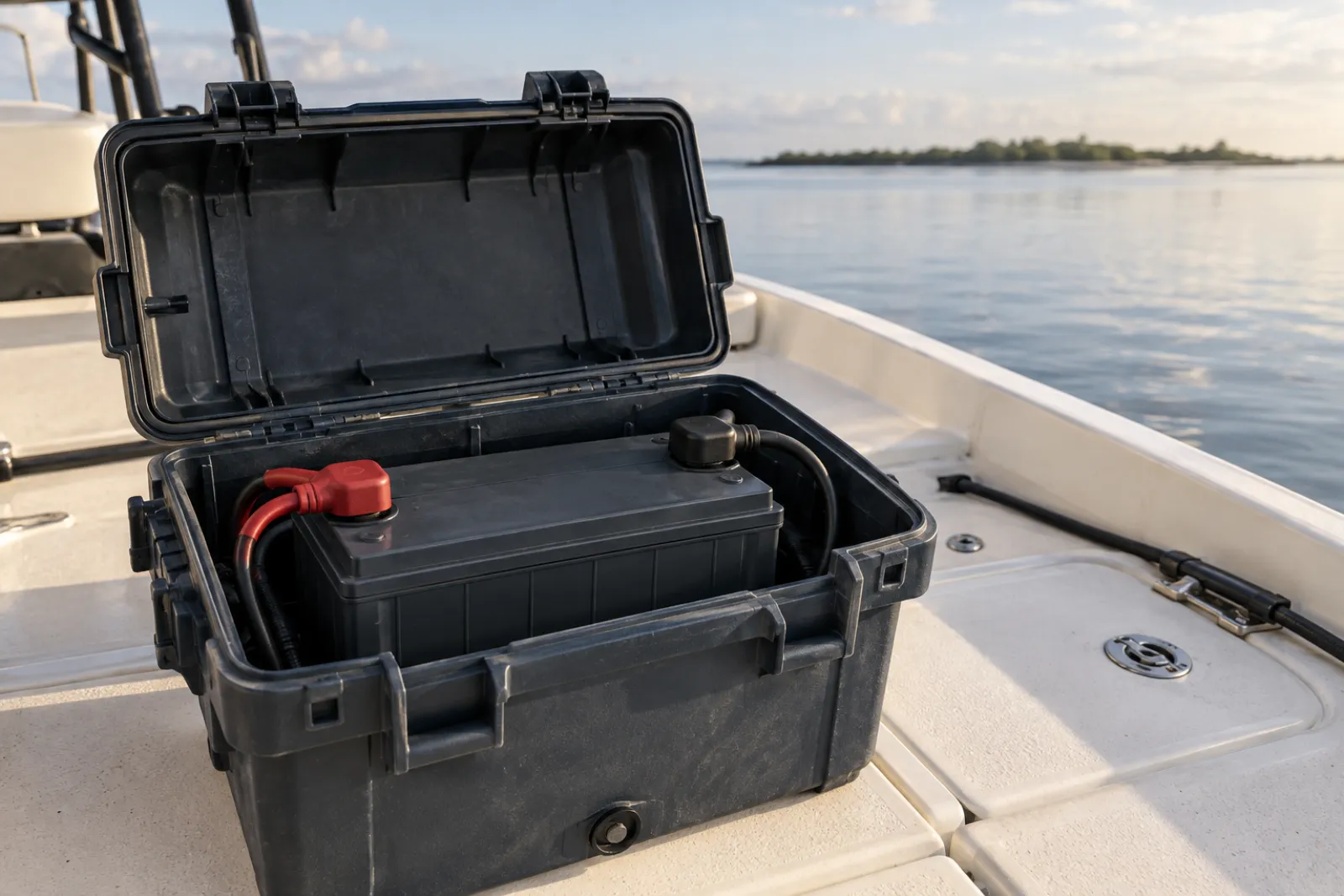
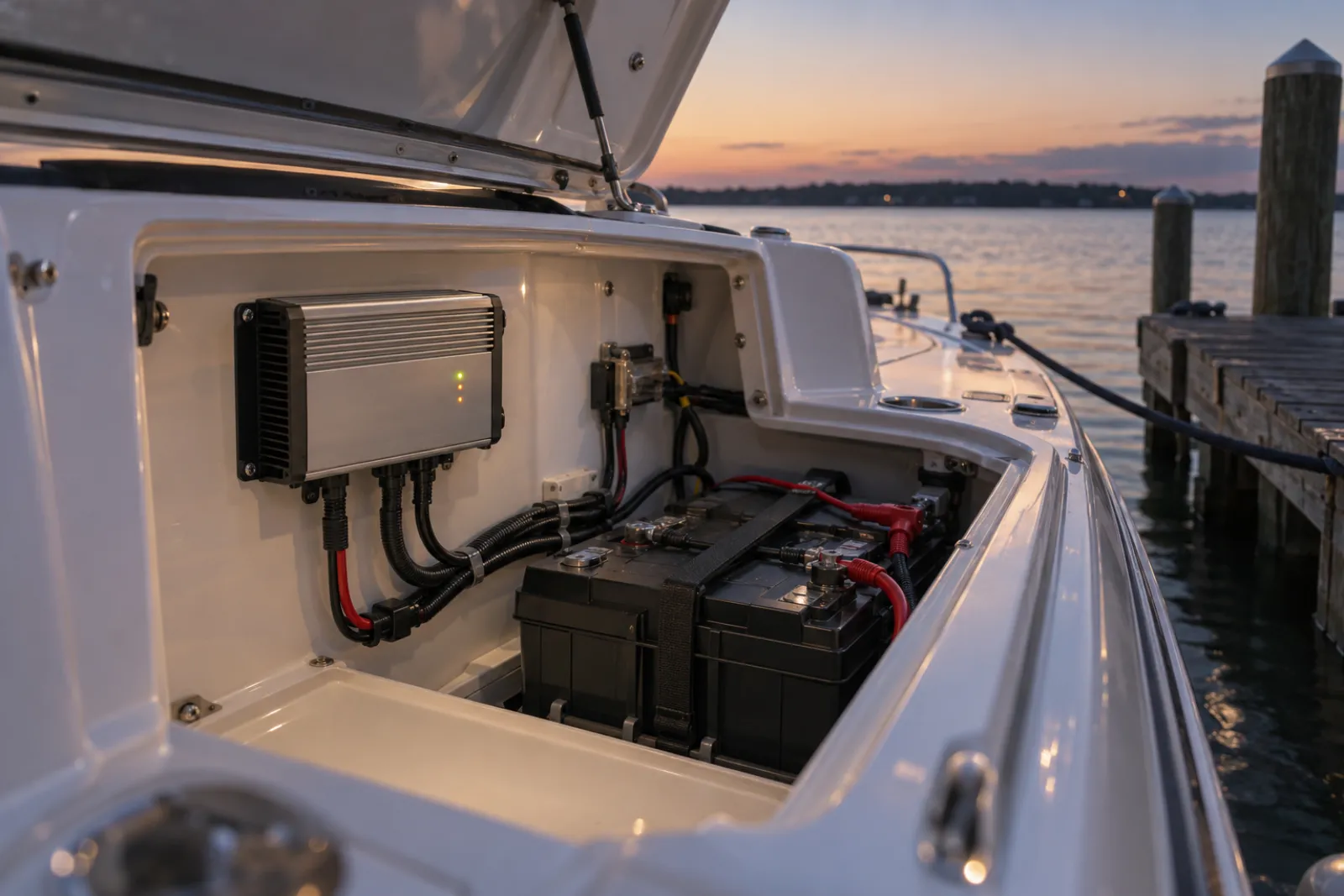
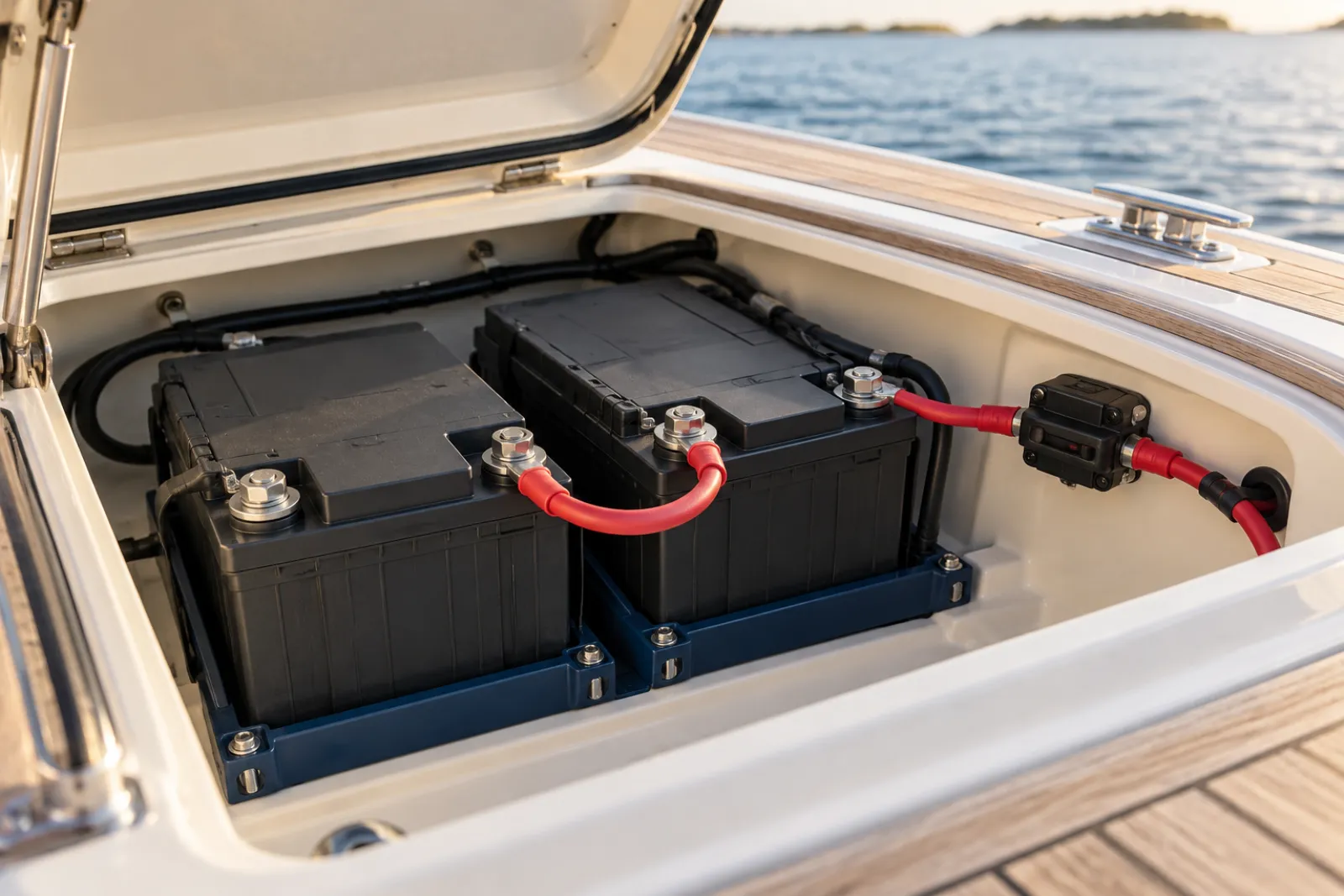
Trolling motor battery in the bow compartment of a fishing boat at dawn

Why Your Trolling Motor Battery Choice Matters

Your motor is only as good as the box feeding it. A motor rated at 55 lb thrust feels weak by lunch on a tired, undersized battery, and a pack that's too heavy for a small jon boat eats into your load capacity before you add a cooler.

Angler running a bow-mount trolling motor along a quiet shoreline

Runtime, Range & Reliability on the Water

Runtime is the whole game. Amp-hours tell you how much energy is stored; your motor's amp draw tells you how fast you spend it. Get that ratio right and you fish a full day. Get it wrong and you're paddling back.

Chemistry changes the math too. A lead-acid battery should only be drained to about half its rating if you want it to last, while a LiFePO4 pack delivers most of its rated capacity and holds steady voltage until it's nearly empty. That's why the same 100Ah label can mean very different time on the water.

Common Trolling Motor Battery Failure Points

Most dead batteries we see die from habits, not defects:

  • Using a car battery. Starting batteries are built for short bursts, not hours of steady draw. They sulfate and fade fast.
  • Chronic undercharging. Lead plates left partly discharged overnight lose capacity every single time.
  • Undersizing. A small battery worked hard runs hot and ages early.
  • Loose, corroded terminals. Resistance at the post means heat, voltage drop and weak thrust.
  • Freezing storage. A discharged lead battery can freeze and crack in a cold garage.

To choose the right trolling motor battery, pick the type and size once and get them right; every one of these problems gets smaller. The table below is the fastest way to narrow it down.

Trolling Motor Battery Comparison Table: Top Picks at a Glance

We built this table because none of the top guides we read had one. Voltage and capacity come straight from each model's name and listing; weight is shown as a class because exact figures vary by revision. Always confirm the current spec on the listing before you buy.

ModelVoltageCapacityChemistryWeight classPrice tierBest forCheck price
Relion RB24V10024V100AhLFPMedium (lighter than 2 lead batteries)PremiumBest overall, 24V bass boatsCheck price
LiTime 24V 100Ah24V100AhLFP, Bluetooth modelsMediumMidBest value lithiumCheck price
Dakota Lithium 36V 110Ah36V110AhLFPMedium-heavy (one pack replaces three)Premium36V high-thrust motorsCheck price
WattCycle 12V 100Ah12V100AhLFPLightBudgetBest budget lithiumCheck price
Relion RB100 (Group 31)12V100AhLFPLightPremiumDrop-in lead replacementCheck price
Bass Pro Shops Power Series AGM12VGroup 31 classAGMHeavyBudget-midBest AGMCheck price
Dakota Lithium 12V 54Ah12V54AhLFPVery lightMidBest for kayaksCheck price

How to read it: voltage must match your motor. Capacity sets your run time. Chemistry sets weight, lifespan and how much of that capacity you can really use. The price tier is relative within this list, not a dollar figure. LFP is short for LiFePO4, the lithium chemistry explained below.

Check price

Found your row? Tap through to see today's price and stock on Amazon.

Trolling Motor Battery Types Compared: Lead-Acid, AGM & Lithium

There are three battery types worth putting on a boat. All three are deep-cycle designs, meaning thick plates or cells built to be drained and recharged over and over. They differ in weight, lifespan, upkeep and how they behave at low charge.

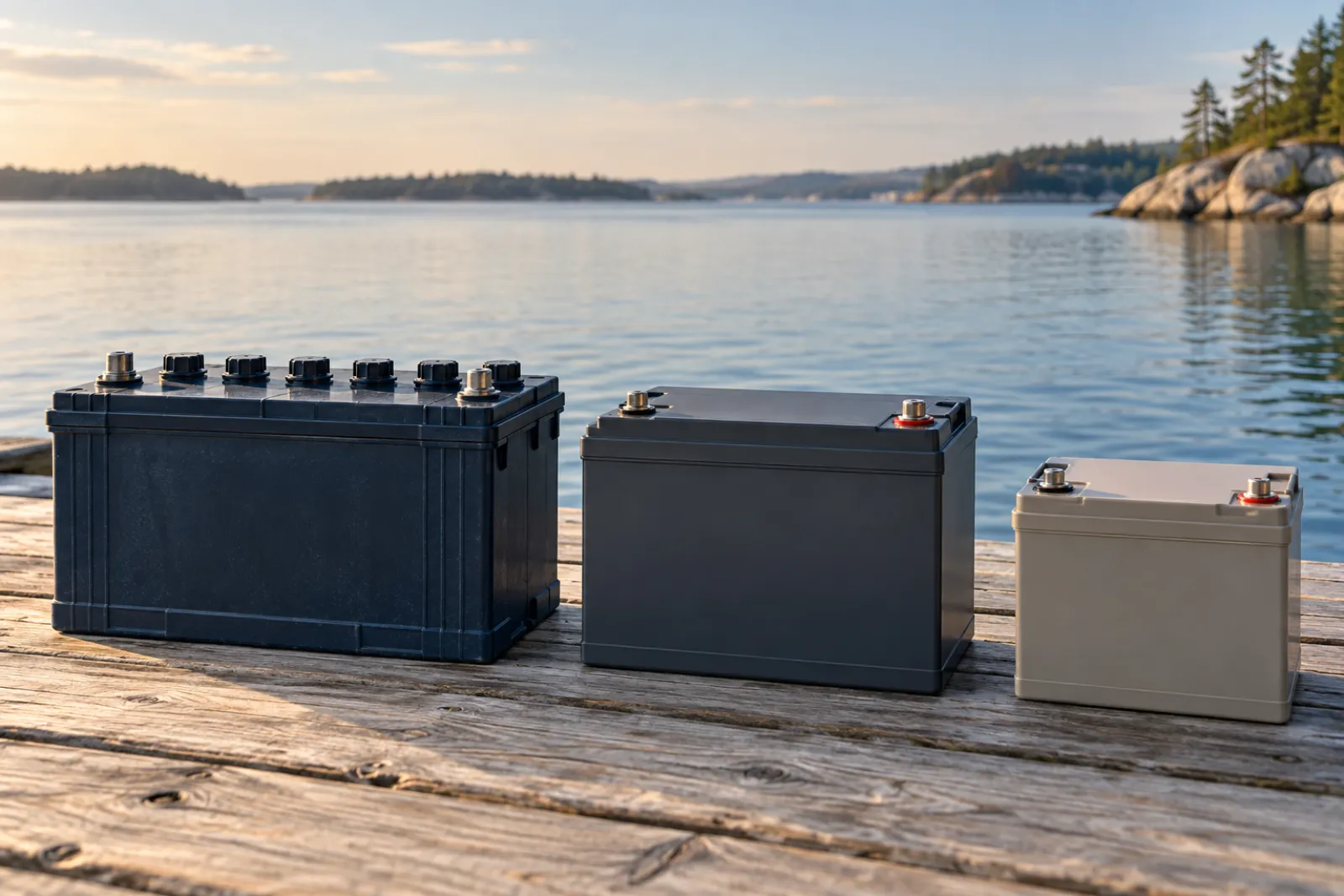
Flooded lead-acid, AGM and LiFePO4 lithium deep-cycle batteries side by side

Flooded Lead-Acid Deep-Cycle Batteries

The old standard. Flooded cells use liquid electrolyte you top up with distilled water, and they vent gas while charging, so they need a ventilated battery box.

  • Upside: lowest upfront cost, sold everywhere, tolerant of basic charging gear.
  • Downside: heavy (a 12V group 27 often runs 50 to 60+ lb), needs maintenance, and voltage sags steadily as it drains, so your motor slows through the day.
  • Lifespan: manufacturers typically rate these in the low hundreds of cycles at 50% depth of discharge.

Good pick if you fish a few times a season and the boat already carries weight well.

AGM Deep-Cycle Marine Batteries

AGM (absorbed glass mat) is a sealed VRLA battery: the electrolyte is held in fiberglass mats, so there's nothing to spill or top up. That makes AGM batteries a clean upgrade over flooded lead acid for small boats where the battery lives near your feet.

  • Upside: sealed and spill-proof, handles vibration and pounding better, lower self-discharge in storage.
  • Downside: still heavy, still only about 50% usable capacity for good life, and sensitive to overcharging, so match the charger profile.
  • Lifespan: typically a step up from flooded. Outdoor Life's fishing writer reported a Deka AGM that kept going more than four years in hard tournament use.

Lithium (LiFePO4) Trolling Motor Batteries

LiFePO4 (often shortened to LFP) stands for lithium iron phosphate, the most stable lithium-ion chemistry on a boat. It's not the cobalt-based cell in your phone. LiFePO4 lithium batteries resist thermal runaway far better, which is why nearly all lithium trolling motor batteries use this chemistry.

  • Upside: roughly a third to half the weight of lead for the same capacity, 80 to 100% usable capacity, flat voltage so the motor pulls hard until the end, fast charging, and cycle ratings commonly in the thousands on manufacturer datasheets.
  • Downside: higher upfront cost, needs a compatible charger, and most won't accept charge below freezing unless they have self-heating.
  • Extras: many models add a battery with Bluetooth monitoring, low-temp cutoff and self-heating pads.

For anyone who fishes often, these usually win on cost per trip, not just performance.

Deep-Cycle Battery Types: Pros & Cons by Chemistry

AttributeFlooded lead-acidAGMLiFePO4 lithium
Weight (same capacity)HeaviestHeavyLightest
Usable capacity~50%~50%~80–100%
Typical rated cycles*HundredsHundreds, higher than floodedThousands
MaintenanceWater top-ups, ventingNoneNone
Voltage under loadSags steadilySags steadilyFlat until near empty
Cold chargingOKOKNeeds heat or low-temp protection
Upfront costLowMediumHigh

*Cycle ratings vary by brand and depth of discharge. Check each maker's datasheet.

Expert tip: Compare cost per cycle, not sticker price. Divide the price by rated cycles at your real depth of discharge. Deep-cycle lithium almost always comes out cheaper per trip if you're on the water more than a dozen days a year.

How to Size a Trolling Motor Battery: Thrust, Voltage & Amp-Hours

Sizing comes down to three questions, in this order: what voltage does the motor need, how many amps does it draw, and how long do you want to run.

Matching Voltage to Motor Thrust (12V, 24V, 36V Systems)

Voltage isn't optional. Your motor is built for one system and the battery voltage has to match it.

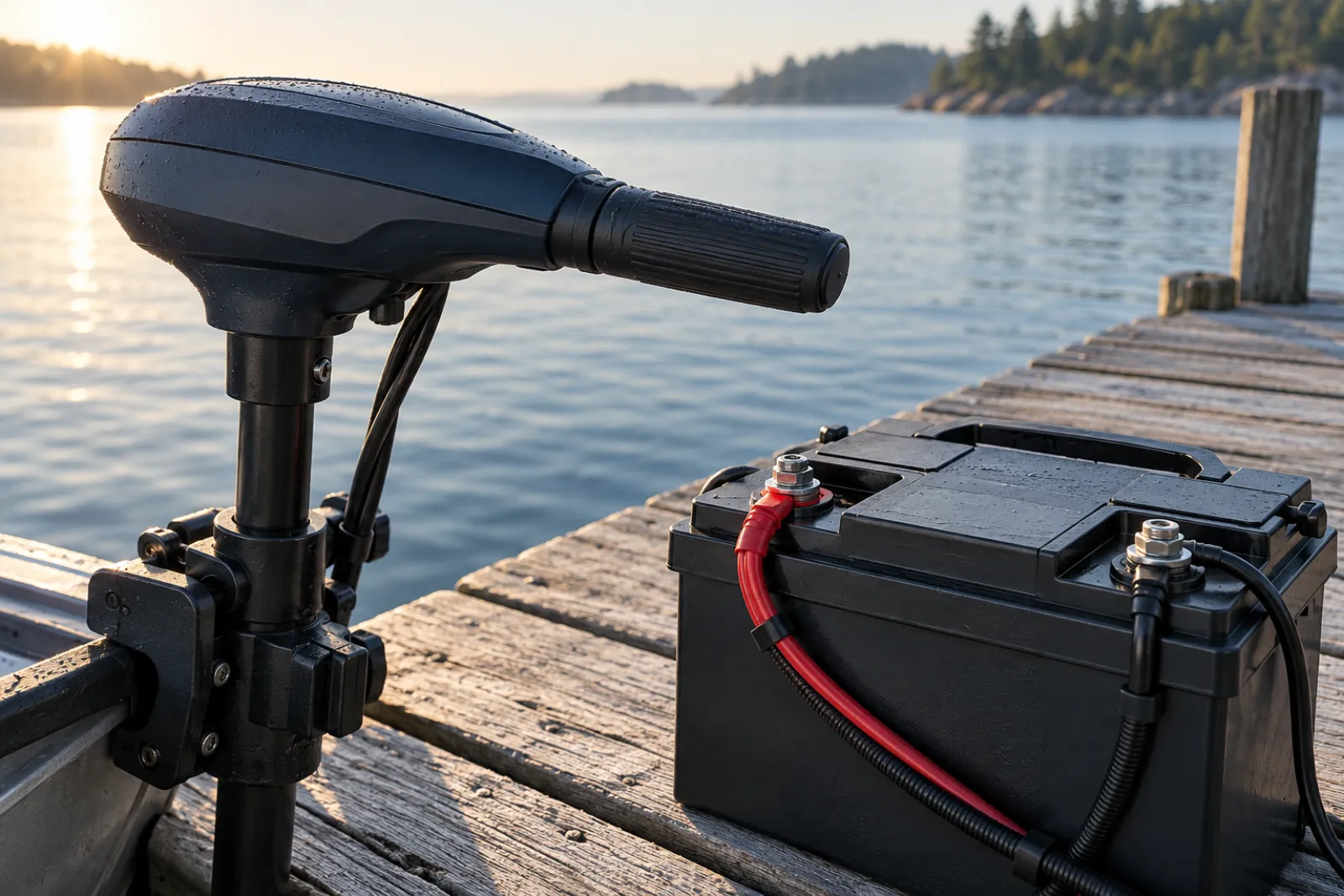
Trolling motor head and battery terminals showing voltage matching
Motor thrustSystemBatteries needed (12V units)Typical boat
30–55 lb12V1Kayak, jon boat, small aluminum
70–80 lb24V2 in series, or one 24V pack16–18 ft bass and walleye boats
101–112 lb36V3 in series, or one 36V pack18 ft+ bass and bay boats

A 12V trolling motor is simple: one battery, two cables. A 24V system or a 36V trolling motor gives more thrust at lower current, which helps efficiency and cable sizing. Check the plate on your motor, or the manual for Minn Kota trolling motors and similar brands, before you buy anything. That's why single packs like a 24V 100Ah or a 36V 100Ah are so popular on bigger boats: one box instead of two or three, and the same battery capacity in far less space.

Power & Amp-Hour Sizing Formula: Thrust to Runtime

Here's the formula we use:

Run time (hours) = usable amp-hours ÷ average amp draw

Usable capacity is about 50% of the rating for lead acid and about 90% for LFP. Draw depends on speed. As a reference, a 55 lb thrust motor pulls roughly 50 amps at full speed per common manufacturer specs, and far less at the low and mid settings most anglers use all day.

Worked example: 55 lb motor, 100Ah battery, averaging about 20 amps:

  • LFP: 90 usable Ah ÷ 20 A ≈ 4.5 hours of steady running
  • AGM: 50 usable Ah ÷ 20 A ≈ 2.5 hours
  • At a light 4 A crawl, TrollingMotors.net's own example gives 100Ah ÷ 4 A = 25 hours on paper

Nobody runs one speed all day, so treat these as a planning range, not a promise. If your math comes out tight, size up. Extra capacity costs less than a long paddle.

Older lead batteries sometimes list minutes of reserve capacity (RC) instead of Ah: how long the battery delivers 25 amps before dropping to 10.5 volts. Divide RC by about 2.4 for a rough Ah equivalent.

Run time = usable Ah ÷ average A

Chemistry
Estimated run time 4.5 h

Battery Group Size Chart (24, 27, 31, 6D, 8D)

Battery group is a BCI size standard. It tells you the case dimensions, which decides whether it fits your tray and battery box.

Battery groupTypical lead-acid rangeCommon LFP fitNotes
Group 24~70–85Ah12V 50–100AhSmallest standard marine size
Group 27~85–105Ah12V 100–150AhMost common trolling motor tray
Group 31~100–125Ah12V 100–200AhHeavy-duty, fits most full-size LFP packs
6D / 8DLarge capacitySingle-pack high-voltage unitsBig boats, needs a large compartment

Measure your compartment before you order. LFP often packs more capacity into a smaller case, so a group 24 space can hold a 100Ah trolling motor pack that would've needed a group 31 in lead. Once you know your voltage and battery size, the picks below are sorted to make the choice quick.

Best Trolling Motor Battery Picks by Category

We chose these from models with a track record in fishing boats, clear specs and a real warranty. No lab bench here: our criteria were published datasheets, owner feedback and how each battery fits the sizing rules above.

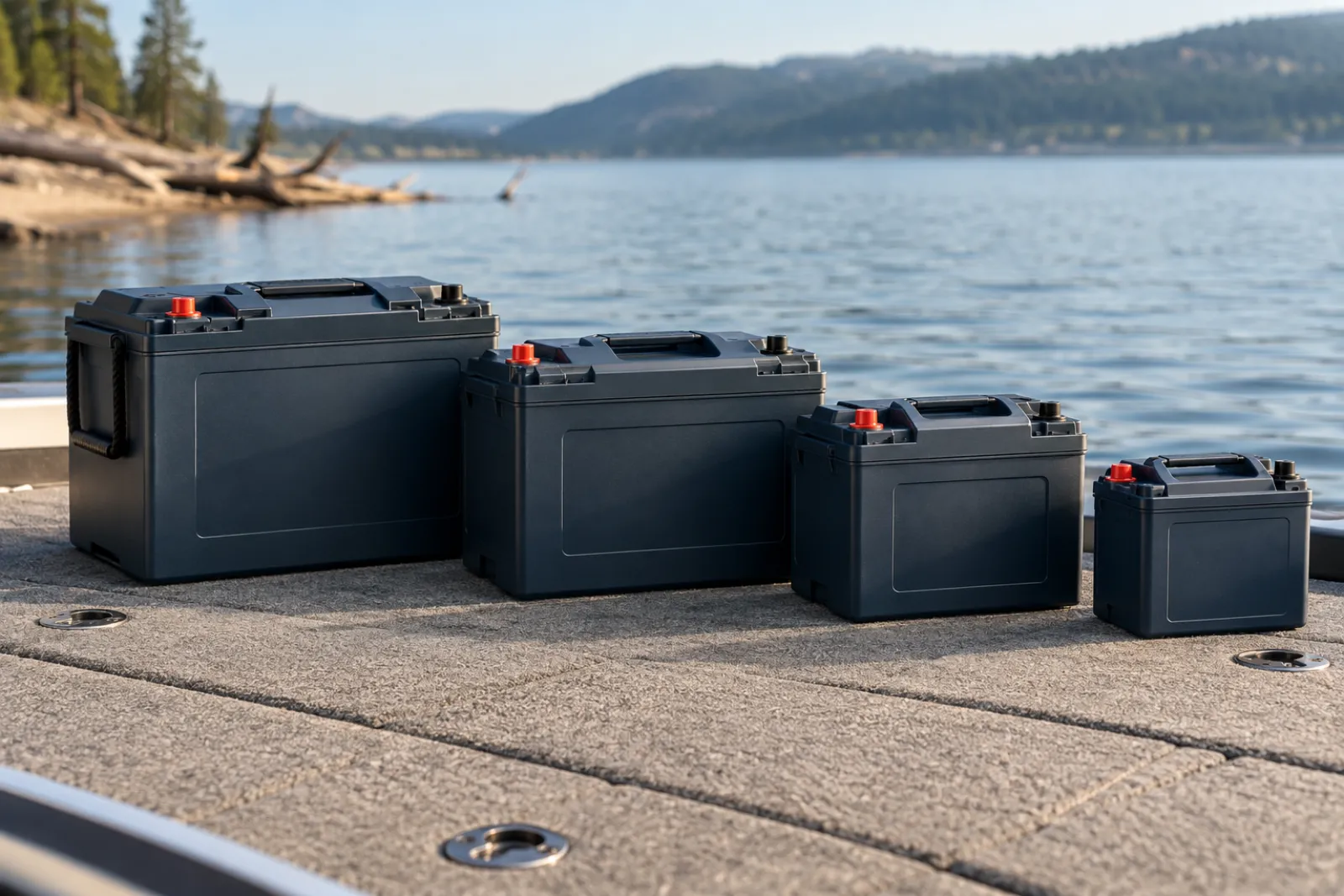
Lineup of 12V, 24V and 36V trolling motor batteries on a boat deck

Best Overall Trolling Motor Battery

Relion RB24V100 (24V 100Ah LiFePO4)

For the most common setup in fishing, a 24-volt bow-mount on a bass or walleye boat, this is the one to beat. One pack replaces two lead batteries, cuts a lot of weight from the bow and keeps thrust steady until late in the day. Relion is a long-established marine battery brand with a strong warranty reputation.

Pros
single-pack design, big weight savings, steady voltage, long rated life
Cons
premium tier; you'll need a matching LFP charger
Check price

Best Budget Trolling Motor Battery

WattCycle 12V 100Ah LiFePO4

This WattCycle pack shows up across many budget lists for a reason: it gives you LFP weight and cycle life at a lower tier than name brands. On a jon boat or small aluminum rig it covers a full day at moderate speed. Two of these in series also make a budget 24-volt bank.

Pros
strong value, light, a 12V 100Ah LiFePO4 battery in a common case size
Cons
check the listing for low-temp protection and current warranty length

If you'd rather stay with lead, a group 27 AGM is the cheapest up-front route, but lithium options like this one usually pay back in a couple of seasons.

Check price

Best Lithium Trolling Motor Battery

LiTime 24V 100Ah LiFePO4

LiTime ranks at the top of search for a reason: a deep catalog of trolling packs across all three voltages, including Bluetooth models, at mid-tier pricing. This 24V model is the sweet spot. It fits a 24V trolling setup in one box, and many versions let you watch state of charge from your phone. For anglers wanting a Bluetooth LiFePO4 battery without premium-tier cost, it's the best lithium battery for trolling motor use at this level, and our best lithium trolling motor value pick.

Pros
strong value, Bluetooth versions, wide voltage range
Cons
confirm your version includes self-heating for cold-water fishing
Check price

Best AGM Trolling Motor Battery

Bass Pro Shops Power Series AGM (Group 31)

If you want sealed, maintenance-free and affordable, a group 31 AGM is the proven choice. It works with the charging setup you probably already own and doesn't mind cold-weather charging. The trade-off is weight and that 50% usable capacity rule.

Pros
budget-friendly, sealed, no special charging gear needed
Cons
heavy, shorter cycle life than LFP, voltage sags late in the day
Check price

Best Battery for Kayak Trolling Motors

Dakota Lithium 12V 54Ah

On a kayak every pound shows up in how the boat sits and paddles. The Dakota Lithium 12V 54Ah is light enough to carry to the launch in one hand yet runs a 30 to 55 lb thrust motor for a morning of fishing at moderate speed. It's also a tidy way to power a fish finder on the same pack. For a heavier kayak or longer days, step up to a compact 100-amp-hour pack.

Pros
very light, compact, long warranty reputation
Cons
the smaller capacity limits full-speed running; plan around your motor's draw
Check price

Still torn between two picks? Pick the one that matches your motor's voltage first. The rest is capacity.

Trolling Motor Battery Certifications & Safety Standards

Most batteries for trolling motors are marketed with badges. Here's what they actually mean, and what to ask.

Marine Battery Certifications: ABYC Standards Explained

The American Boat and Yacht Council (ABYC) writes the safety standards US boat builders follow. Standard E-10 covers storage batteries in general, and E-13 covers lithium-ion installations. Here's the catch: ABYC doesn't stamp individual batteries. When a listing says "ABYC compliant," it usually means the battery and its install guidance are designed to meet those rules. That's still useful, but it isn't a lab certificate.

For real third-party proof, look for UN38.3 (the transport safety test every lithium pack must pass to ship) and a UL listing such as UL 1973 on premium lithium marine batteries. Brands that mention "certified components" should be able to tell you which ones.

Battery Management System (BMS) Protection

Every LFP pack worth buying has a battery management system. The BMS watches each cell and cuts power before something goes wrong: overcharge, over-discharge, short circuit, overcurrent and extreme temperatures. It also balances cells so the pack ages evenly. A good BMS is the reason LiFePO4 is safe in a bass boat. A weak one is why cheap packs shut off under a hard amp draw. Check that the continuous discharge rating (for example 100A) sits comfortably above your motor's maximum draw.

Warranty & Waterproof (IP) Ratings

The IP code has two digits: dust, then water. IP65 handles spray and rain. IP67 means dust-tight and survives immersion to about 1 meter for 30 minutes, which is the rating you want for paddle craft or an open compartment. Amped Outdoors, for example, lists IP67 on several of its trolling packs.

On warranty, read the length and the terms. Abyss offers a 5-year warranty with an extension program, and several LFP brands go much longer. A long warranty is a brand betting on its own cells. That's a signal worth weighing before you check the price.

Saltwater vs Freshwater Trolling Motor Battery Suitability

Any good trolling battery works in both. Salt changes the upkeep, not the chemistry.

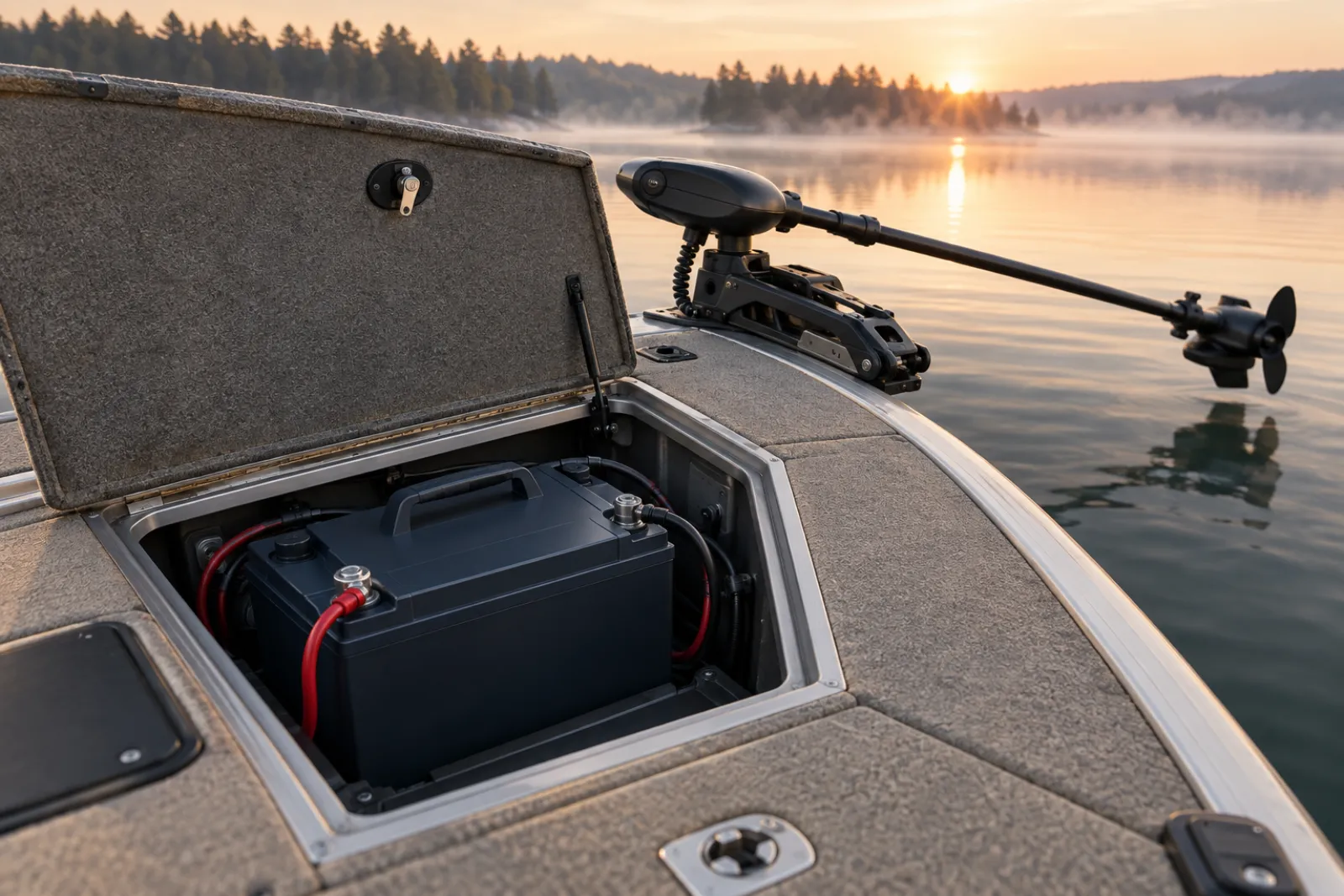
Sealed marine battery with protected terminals on a saltwater skiff

Deep-Cycle Marine Battery: Corrosion Resistance & Sealed Terminals

Salt spray and humid air attack exposed metal. For inshore and bay fishing, favor sealed deep-cycle marine batteries (AGM or LiFePO4) with corrosion-resistant terminals, protective terminal boots and a lidded battery box. Flooded batteries vent gas and can wick salty moisture into the terminals, so they need more attention near the coast. Rinse terminals with fresh water after salty trips, dry them and coat them with dielectric grease. Choose products clearly built for marine use rather than generic RV or solar packs.

Best Trolling Motor Deep-Cycle Battery for Saltwater

For a saltwater skiff or bay boat, the trolling motor deep-cycle battery we'd pick is a sealed LiFePO4 trolling motor pack with an IP67 case and a stated marine use rating, such as the Relion or Dakota Lithium models above. They don't vent, they don't need water, and less weight helps in skinny water. On a tighter budget, a sealed AGM is the safer choice over flooded. Pick the chemistry here, then match it to your voltage in the table above.

Trolling Motor Battery Charging & Maintenance

A well-charged battery lasts years. A neglected one lasts a season or two. This is where most of your battery life is won or lost.

How to Charge a Trolling Motor Battery Correctly

  1. Match the charger to the chemistry. LFP needs its own profile; AGM needs an AGM profile. Using the wrong one either undercharges or cooks the battery.
  2. Charge after every trip. Don't let lead sit discharged overnight. LFP is more forgiving but still likes it.
  3. Fully charge before storage and before a big day. An onboard multi-bank unit makes this automatic at the dock.
  4. Charging on the water: a DC charger (DC-to-DC) pulls from your outboard's alternator and safely feeds the trolling bank while you run. It's the cleanest power setup for long days away from shore power.
Onboard marine charger connected to a trolling motor battery at the dock

Extending Battery Life Between Trips

  • Keep lead batteries above 50%; LFP is happy anywhere from 20 to 100%.
  • Tighten and clean terminals monthly.
  • Don't mix old and new batteries, or different brands, in one bank.
  • Keep the trolling bank separate from your cranking battery so the engine always starts.
  • If your battery has Bluetooth, check cell balance now and then. It flags trouble early.

These habits keep the pack at optimal performance for years.

Cold-Weather & Off-Season Storage

Cold slows every battery. Lead loses usable capacity in the cold and can freeze if left discharged. Most LFP packs block charging below about 32°F (0°C) through the BMS; if yours powers off from low temperature, warm it indoors and it'll reset. Self-heating models solve this for early-spring anglers.

For winter, store lead fully charged on a maintainer. Store LFP at roughly 50 to 60% charge, disconnected, somewhere dry and above freezing. Buying a matched battery-and-charging kit is the simplest way to get this right.

Check price

Want a matched battery and charger? Many listings sell them as a kit. See today's options on Amazon.

Wiring Trolling Motor Batteries: Series vs Parallel

Two ways to connect two or more batteries, and they do opposite things. Series adds voltage. Parallel adds capacity.

B1 12V–+ B2 12V–+ = 24V

Connecting Batteries in Series for Higher Voltage

Wiring 12V batteries in series is how you build a 24V or 36V system. Run a jumper from the positive post of battery 1 to the negative post of battery 2. Your motor's negative lead goes to battery 1's negative; its positive lead goes to battery 2's positive. Two batteries give 24 volts; add a third the same way for 36. Capacity stays the same: two 100Ah batteries in series give 24 volts at the same capacity.

Diagram in words: Motor (–) → B1 (–) · B1 (+) → B2 (–) · B2 (+) → Motor (+).

With LFP packs, the batteries must be identical and must say they support series use. Check the listing, since some limit how many can be stacked.

B1 12V–+ B2 12V–+ = 12V · 2×Ah

Connecting Batteries in Parallel for More Capacity

Wiring batteries in parallel keeps voltage the same and adds amp-hours. Connect positive to positive and negative to negative, then take the motor leads from opposite ends of the bank (positive from battery 1, negative from battery 2) so both share the load evenly. Two 100Ah packs in parallel give 12 volts at 200Ah, which is double the run time on a 12V motor.

Two batteries wired in series with a jumper cable and inline circuit breaker
Video · how to wire trolling motor batteries in series (Minn Kota)

Wiring Safety Notes & Gauge Sizing

  • Fuse it. Install a circuit breaker close to the battery, sized to your motor's spec (often 50 to 60 amps). It's also what ABYC calls for.
  • Size the wire for length and current. Most trollers up to 24 volts use 6 AWG for shorter runs; long runs to the bow may need 4 AWG. Your motor manual lists the exact wire gauge by distance.
  • Crimp, don't twist. Use tinned marine lugs and heat-shrink.
  • Connect last, disconnect first: the positive to the motor goes on last and comes off first.

Trolling Motor Battery Buying Guide: What Else to Consider

Chemistry and size cover most of the decision. These factors settle the rest.

Weight & Boat Capacity

Check your boat's capacity plate. A pair of lead batteries in a 24V system can weigh well over 100 lb, most of it in the bow. Swapping to LFP frees that weight for gear and people, and it helps the hull sit level and plane faster. On a kayak or canoe, weight is often the deciding factor on its own.

Warranty & Cost-Per-Cycle Math

Real cost = purchase price ÷ usable cycles. Say a lead battery is rated for a few hundred cycles at 50% depth and an LFP pack for a few thousand at 80%+. Even at several times the up-front cost, the newer chemistry often costs less per trip, and it delivers more usable capacity each time. The warranty tells you how long the maker expects that math to hold. Long warranties, clear terms, and a US support line are worth paying for.

Bluetooth Battery Monitoring Apps

A battery with Bluetooth sends state of charge, voltage, current and temperature to your phone. That turns "how much is left?" from a guess into a number, so you know when to head in. It's especially handy on multi-battery banks where each pack sits hidden in a compartment. Not essential, but once you've used it, it's hard to go back.

Weighed the extras? Then it's just a matter of matching voltage and capacity from the table and checking today's price.

Check price

Trolling Motor Battery FAQ

What Kind of Battery Should You Use for a Trolling Motor?

A deep-cycle battery: flooded lead-acid, AGM or LiFePO4. For frequent anglers, LFP is the best long-term value. For occasional use on a budget, AGM is the easy choice.

How Long Will a 100Ah Battery Run a 55lb Trolling Motor?

At a mixed average of about 20 amps, a 100Ah lithium battery gives roughly 4 to 5 hours; a same-size lead battery gives about half that because you should only use 50%. At full thrust (around 50 A), expect under 2 hours even from LFP. Low-speed crawling stretches it much further.

What Size Battery Is Recommended for a 55lb Thrust Trolling Motor?

A 12V deep-cycle battery with enough capacity for a full day, usually about 100Ah. Look for a group 27 or 31 in lead, or a same-size LFP pack, which often fits a group 24 or 27 space.

Is a Lithium Battery Better Than a Lead-Acid Battery for a Trolling Motor?

For most anglers, yes. A trolling motor lithium battery is much lighter, delivers nearly all of its capacity at steady voltage, charges faster and lasts many more cycles. Lead-acid batteries still make sense if you fish rarely or need the lowest up-front cost.

What Is the Difference Between a Trolling Motor Battery and a Regular Car Battery?

A car or automotive battery is a starting battery: thin plates made for a short, heavy burst to crank an engine. A trolling battery is built for deep discharge, with thick plates or LFP cells built to deliver steady current for hours and recover from deep discharge. Using a car battery for trolling ruins it quickly.

How Many Amp Hours Should a Trolling Motor Battery Have?

For most boats, 100Ah per battery is the practical target. A kayak can get by on a 50 Ah battery or a bit more. Big 36V boats running long days often go larger per pack. Use the formula above: usable Ah ÷ average amps = hours.

Can I Connect Trolling Motor Batteries in Series or Parallel?

Yes. Series raises voltage for higher-thrust motors; parallel raises capacity at the same voltage. Use identical batteries, fuse the bank, and confirm the model supports the connection.

Does a Lithium Battery Damage a Trolling Motor?

No, as long as the voltage matches. A LiFePO4 battery rests slightly higher than lead (around 13.2 to 13.4V), so the motor may run a touch faster, but that's within the normal range for most motors. Check the maximum input voltage in your manual; Minn Kota trolling motors are run on LFP packs every day across the country. Reports of battery damage usually trace back to mismatched voltage or poor wiring, not chemistry.

What Group Size Trolling Motor Battery Do I Need?

Measure your tray. Group 27 and 31 are the most common for trolling; group 24 suits smaller boats and many LFP packs. Large single-pack 24V and 36V units may need 6D or 8D space.

Are Trolling Motor Batteries Deep Cycle?

They should be. Every battery you use for trolling motor use should be a true deep-discharge design. Dual-purpose marine batteries work in a pinch, but a dedicated deep-discharge design will run longer and last more seasons.

Check price

Got your answer? The picks above link straight to today's price and stock.

Fishing boat with trolling motor deployed at sunset

Get the Right Trolling Motor Battery for Your Boat Today

Here's the short version. For most 24-volt boats, the Relion RB24V100 is our best overall pick. The LiTime is the value pick, the WattCycle wins on budget, the Bass Pro Power Series AGM is the sealed lead option, and the small Dakota Lithium pack is the one for kayaks.

Match the voltage, size the amp-hours to your day, and you'll stop watching the battery gauge and start watching the water. This guide was last updated September 30, 2026.

Check price

Prices on Amazon change daily. Check today's price before your next trip.